Ha! You didn’t even notice it, but something has definitely changed. GLOT is different. Believe it or not, you’re not reading this the same place as you would’ve been last week.
Server’s changed. After the seamless file copy from the old to the new, the nameserver pointers repropagate, and no one’s the wiser. Like *that*.
It’s their own dumb fault. I’d been hosting homepie.org with Lunarpages for four years and had few problems. Of course this year I’m a little strapped for cash, but since they were running a discount on hosting for two years, I was planning on taking them up on it (long-term planning, y’see?). $118 is a chunk o’ change, but this internet thing is important to me. So I asked for it as a gift. In fact, I asked my host if there was some sort of “gifting page” I could send people to. By way of response, they charged my card the $118. Oops.
Long story medium, I got it back, then a couple days later had an unannounced auto-renewal at the normal $95 yearly rate, canceled my service, canceled my card, had the charge go through anyways, negotiated the lengthy cancellation process, had to accept paying them for the domain fee… somewhere along the way a friendly girl named Lynae suggested that I just pack up and put all my stuff on her server. She’s using nowhere near the “unlimited space” or “unlimited bandwidth” provided for in her hosting plan, and she’s not quitting the internet anytime soon. So yeah. We’re just that much closer now. It’s even better than sharing a bedroom, I say. Wasn’t even that hard. Like pulling a switch.
Welcome to the new, cheaper, more convenient, same old Glot.
It’s sad that some beautiful things last but a short time. That does mean you don’t have to wait around for them to finish, though.
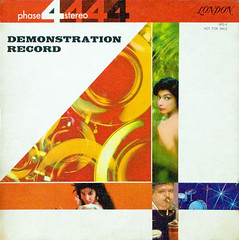
I like old records. I’ve pontificated at length before. This particular wonderful ol’ dusty gem is an ephemeral release designed to promote—of all the things to promote on a record—a new way of recording records. Yes, it is a Demonstration Record for Phase 4 Stereo. That’s it’s name, pretty much. Inside the folding cover there’s a lengthy explanation as to what “Phase 4 Stereo” is, and how it differs from the previous three phases. It goes on and on about how great the Phase 4 is, and the compilers seemed to have gone out of their way to find music that’s dynamic and at times dare-I-say-it “zany.” However, I choose to keep this explanation brief; partly because it fits the title and partly because the record itself isn’t that long (all of 25 minutes : 38 seconds). Moving on: samples!
Colonel Bogey
Granada
Tiger Rag
You Are My Lucky Star
Pretty neat, if you ask me. But you might be asking: Why the demonstration? Why now? That Winterhalter nonsense he blogged about last month was justified for four paragraphs before a name even got dropped… Well, there is good reason. Two days ago a little late Christmas present slipped through and I’m now the proud owner of a pristinely aftermarket Zoom H2 Handy Recorder. The thing is simple, and amazing, and simply amazing. If I could leave that as my review I would. But as a sort of placeholder—and a fine demonstration of it’s ease of use—here are the 10 tracks from this ephemeral and exotic throwback sensation beautifully presented in convenient downloadable ID3-tagged MP3 (all recorded, transferred, cleaned up, and encoded in little more than an hour).
Well, I’ve already violated one of my rules. I said I was gonna call it an iThing—but now I’ve gone and named the beast.
See, even though it was the unlikeliest gift in the world, even though I specifically asked not to be given one, I’m still somehow feverishly tapping this out thumbprint by thumbprint at this very minute… on an iPhone. Which, of course, gives you some idea of the time involved, but that’s not really my point. My point is this: it’s absolutely bizarre.
There are many things I could write about: my surprise, my well-meaning reticence, my amazed gratitude, my quick and unplanned attachment, or perhaps the many ways it’s already changed my actions, the dissonance of having a status symbol when I’ve not earned its status, or how (in the past) I always’ve had a white one but could only get the 8GB in black so settled for a white case. I think they’re interesting stories, but maybe you had to be there.
The question is one I’ve never asked before. I wanna know, from those of you who still read this neglected yet beloved multi-spectral personal monolith, is it a good idea to write a lot of short stuff? I mean, would that get annoying? It’s obvious to me now that there exists the technology to blog about what you eat for every meal, every day, for the rest of your life. But maybe I could blog glot from the woods, or during a parade, or maybe in bed next to my exhausted girlfriend while on a mind-bogglingly extended multi-family Christmas? It’s just a pattern I’d like to pursue, and knowing me it’s possible that brevity could (at some point) be abandoned. I just want opinions. It’s the age-old question, really: to blog, or not to blog?
My birthday falls exactly 12 days before Christmas. Yes, there’s a song; no, nobody sings it. Although there are certainly worse calender dates (like February 29th, or Christmas itself), the placement has always been problematic. But I made a discovery the birthday before I went to college: the present season goes better if I have a theme.
Two years after that I was going to Australia. Excellent year as far as “stuff I’m definitely gonna use,” and made me happy. I think a theme is called for this year. Considering my current state of unemployment, and the protracted lack of funds which that implies, this year I want:
to maintain my quality of life!
Yes, that’s right. Sometimes it’s just nice not to have to sacrifice the enjoyable things. Things like:
web-hosting, which my host currently has an excellent deal on: $4.95/month with unlimited storage and bandwidth… if you purchase it for two years ($118.80)
Michael Crichton, my favorite childhood author, has died. He is survived by his fans’ love (and blood relatives, I suppose). I’ll never forget the postulated intelligent bacteria in “Sphere,” caught in a human machine, which it concludes is a test meant for itself. And no, I’ll never forget the bit in “Next” where he fictionalizes one of his critics then makes him a gay baby-pedophile with a micropenis. You weren’t always easy to love, Crichton; you took unpopular scientific positions and had odd tastes, but you made me strong with wonder. Anyone who’s had a dinosaur named after them (Crichtonsaurus) has done good in my book. Resquiscat in pace, artifex celebrus.
In the course of looking up his many writings, I came across a remarkably prescient speech Crichton wrote in 1993 entitled “Mediasaurus.” In it he criticizes what we would now call “Old Media,” and predicts its downfall to the internet. It contains this charmingly dated yet quite correct analysis of modern media:
Once Al Gore gets the fiber optic highways in place, and the information capacity of the country is where it ought to be, I will be able, for example, to view any public meeting of Congress over the Net. And I will have artificial intelligence agents roaming the databases, downloading stuff I am interested in, and assembling for me a front page, or a nightly news show, that addresses my interests. I’ll have the twelve top stories that I want, I’ll have short summaries available, and I’ll be able to double-click for more detail. How will Peter Jennings or MacNeil-Lehrer or a newspaper compete with that?
His perception was, by and large, that big media companies had devolved so much they could never survive the coming revolution. He predicted they had ten years left, max. Politically, he always seemed the intelligent, thoughtful, and informed contrarian—an endearingly rare combination. That quality seemed centered on his insights into how uncivil American culture, and by extension the media, had become. But he was inextricably a part of that media. He never tried to escape it. Quoted from a follow-up interview 15 years later:
The truth is, we live in an age of astonishing conformity. I grew up in the 1950s, supposedly the heyday of conformity, but there was much more freedom of opinion back then. And as a result, you knew that your neighbors might hold different views from you on politics or religion. Today, the notion that men of good will can disagree has disappeared. Can you imagine! Today, if I disagree with you, you conclude there is something wrong with me. This is a childish, parochial view. And of course stupefyingly intolerant. It’s truly anti-American. Much of it can be laid at the feet of the environmental movement, which has unfortunately frequently been led by ill-educated and intolerant spokespersons—often with no more than a high-school education, sometimes not even that. Or they are lawyers trained to win at any cost and to say anything about their opponents to win. But you find the same intolerant tone around considerations of defense, taxation, free markets, universal medical care, and so on. There’s plenty of zealotry to go around.
Now, did you catch that? The careful contrarian will always be willing, even eager to perpetrate paradoxical (yet valid) criticism. And I respect him for both calling out boogiemen and acting as a boogieman at times. I respect that he was so intelligent that he recognized the necessity for it. Or maybe I love that he was smart enough to understand it yet dumb enough to do it himself. No one should be too perfect.
He was good at a kind of writing that sells books and makes entertaining movies—that can’t be underestimated and will surely be remembered. However, I’m sure many will remember him for the contrarianism. Maybe that’s what’s needed or maybe not. But I, I will remember him for the gift of imagination (quite literally). The following passage in Sphere was one of the most illuminating things I read in my young life. I think you’ll understand why:
On your planet you have an animal called a bear. It is a large animal, sometimes larger than you, and it is clever and has ingenuity, and it has a brain as large as yours. But the bear differs from you in one important way. It cannot perform the activity you call imagining. It cannot make mental images of how reality might be. It cannot envision what you call the past and what you call the future. This special ability of imagination is what has made your species as great as it is. Nothing else. It is not your ape nature, not your tool-using nature, not language or your violence or your caring for young or your social groupings. It is none of these things, which are all found in other animals. Your greatness lies in imagination.
The ability to imagine is the largest part of what you call intelligence. You think the ability to imagine is merely a useful step on the way to solving a problem or making something happen. But imagining it is what makes it happen.
This is the gift of your species and this is the danger, because you do not choose to control your imaginings. You imagine wonderful things and you imagine terrible things, and you take no responsibility for the choice. You say you have inside you both the power of good and the power of evil, the angel and the devil, but in truth you have just one thing inside you—the ability to imagine.
Otherwise known as the Big Summer Trip that Never Was. Just didn’t pan out, what with being unemployed and gas prices topping over $4.50. It being fall, seems like this summer’s trip probably won’t happen. I’ve been keeping notes, and we sure had some big plans. Mighty big plans…
Sigh. Maybe in a better year I’ll come and visit this little post o’ mine and negotiate my way back to an awesome trip. It’s not as we’ve never pulled this sorta thing off before. Better luck next time.
I think I have good taste. In epic thrift store excavations, I’ve gone through hundreds of used records—probably thousands. More than I wanna think about it. There are a lot of bad ones. Mostly, one hopes that one may find something funny to share with one’s friends. Old stuff is weird (admit it). But oh, there are some gems, and usually they don’t fall out of the cracked wooden bin and yell “I’m worth buying off Ebay for $50! Here I am for ¢50!” It takes a trained eye to efficiently sift through the absolute junk at most places.
Or a trained ear. Finding an incredible record has a lot to do with knowing what you like in the first place—although for those wanting to take up the hobby, it’s perfectly reasonable to make it up as you go along. A good place to start? By all means, judge by their covers. Me, I happen to know that I like gypsy music. I pick up many records simply because they contain in their titles one of these: Gypsy, Roma, klezmer, or Bulgaria. In general I also recommend looking out for: home recording, demonstration, spectacular, incredible, “_____ and the [word intensifier]s,” Moog, olde tyme, fart, and dinosaur. It’s a wide net, a rough algorithm, but it get’s results.
Which is what brings me back to “gem.” I got one. I wasn’t able to actually play it until I found a new record player on the street (thank you, city of cannibals). Even after I discovered its magnificence I didn’t pick up the phone on the ol’ Share-The-Love hotline until a roommate suggested it. And then I had to fiddle with knobs and buttons and wires and other esoteric equipment, only to discover that no matter what I did, the digital transfers just didn’t measure up to my high standards. I’m a wizard with audio software… but there’s no way to get pristine audio from salvaged parts. Get what you pay for, I guess.
But wait, what was this musical masterpiece, I hear you say? Let’s listen to the first track:
Even through my peasant’s needle, you can hear the tambourine sparkle… the horns shimmer… the tubas thump… the piano tinkle… the flutes shriek. It’s exciting! It’s powerful! We’ve heard this song before, but not like this. Easy listening and exotica both seem to apply, but can’t measure the appeal of the real nifty fifties, big bang band, swank-ocracy. Mostly the album is made up of low-key low-tempo stuff, soothing music that might be played without irony on KWXY, which might very well bore you. The poppy ones sure do pop though. On all of them, the arrangement is top-notch and the production values are beyond reproach.
This makes sense considering that the arranger was none other than Hugo Winterhalter, musical director at RCA for more than a decade. This album is dated 1960. For the time, I’m sure, it was somewhat standard. It’s a formula: take a bunch of songs people know, ones that you can tie together with a theme, write them for ensemble, make it modern and “now!”; you have yourself an easy sell. It’s a formula, and it worked. Still does.
Some say stuff like this is more craftsmanship that artistry. It’s the carpenter’s work, not the sculptor’s. I had a music teacher who made the same comparison between Bach and Mozart. He said that while Mozart was a genius, transcended forms and gave the world beautiful music heard neither before nor since (etc., etc.), Bach was simply working within established convention—and when you wanted a fugue, he made the best. They were differently brilliant. Both men became immortal through their music. If you’re like me, though, you have to respect Bach a little bit more. It’s a clever mind that can conjure immortality working with someone else’s rules. I’m thinking that Mr. Winterhalter was a Bach fan.
Now I’m getting a little antsy thinking about how poor my equipment is, and how enjoyable some of the actual songs are, and how there’s hardly any CDs of Winterhalter available, and how it might be up to me to handle this guy’s continued existence. Then I remember the long tail, realize I’ve been praising the guy for seven paragraphs, and things are probably gonna be ok. I’m hesitant about uploading the good stuff (hand-restored LAME V2 mp3s) because I understand perfection, and I understand pragmatism, and I understand that they aren’t the best of friends. Let it be known across the land that I sadly consider these songs as “orphan works,” and hereby claim stewardship of them until someone better steps up. For goodness’ sake, even if you have a better record player step up. Here are the songs from “Hugo Winterhalter Goes… Gypsy!” that will thank you if you do:
Hungarian Dance No. 5 (2:53)
The Back of Her Head (3:08)
Hora Staccato (3:12)
Golden Earrings (3:46)
When a Gypsy Makes his Violin Cry (3:08)
Francesca (3:17)
Csárdás (4:32)
Zigeuner (3:16)
Gypsy Don’t You Cry (3:53)
Gypsy Love Song (2:58)
Total playing time – 34:05
Without further ado, I give you the imperfect recording of my favorite thrift store record in the past year:
I’m just trying to prove it’s a labor of love. For the record, no, it doesn’t make sense to do this custom CSS work when no one but me will ever work with it. Pleasure isn’t always sensible.
Considering the current financial climate, both personal and national, I feel forced to justify the frittering waste of several hours of time that is updating one’s admin screen. So here goes (prepare for long sentence): it’s an exercise of skill which not only keeps the mind sharp, provides a small bit of accomplishment, and is something to show off, but reasserts and reminds me every time I login of my personal sense of style, a style which is particularly energizing and, well, awesome. I like it. Do you?
It’s a great modern fallacy to think that not everyone is a futurist.
Please consider this: if you’re living and breathing, here on this earth, it’s fair to say you need to figure out where you’re sleeping tonight. And beyond that, you ought to know what your going to do for food and water, and what you’ll do for it tomorrow, right? Then the next day. Then the next. There’s mutual funds, 401Ks, mortgages, all the way through burial insurance—and if you have them, you have them on account that you think you know something about the future. If so, you’re a futurist—predicting the unpredictable for your own well-being. Nothing special. The people we might call “futurists” are just the ones who go a little further, who get a little creative, who think up the amazing stuff that makes things seem weird and different.
Futurists like the iPhone (those that think of such things). That new one coming out tomorrow I mean,the one with location-sensing GPS built into it. That’s a wishlist biggie. With an iPhone you can reasonably take the web’s mountain of available knowledge anywhere. Mohammad doesn’t need to go to the mountain; the mountain can come with him (in convenient molehill size). To follow the metaphor… if it shall come to him, the mountain must know where he is. That’s the location-sensing, location-aware internet: it comes to you. Near a grocery store, and one’s grocery list will pop up. Outside a restaurant, the restaurant reviews magically appear. We’re allowed to dream crazy dreams that might happen one day… picture something like network-enabled telepathy: normal people walking down the street, transmitting data of them walking down the street, to others walking just around the corner, and suddenly everybody can see around all the corners and we get something like a real-time GoogleMaps Street View. Techno-clairvoyance, it could be. Someday perhaps a new Transparency will replace the role of stodgy old button-up Security, light shining over dark forever and for good. These are things I have heard dreamt of.
Apparently, I’m the only futurist who rides public transit. It seems odd that few analysts seems to have analyzed thusly, but iPods have always seemed a little… alienating. The earbuds double as earplugs. Have you ever been privileged as captive audience to a stranger’s lengthy phone conversation? Perhaps chose to cloister yourself away from them and escape into your own idiosyncratic cinematic push-button music-video reality? No difference, you and them. You’re each off in your own little world. Personally, I know that if I got an iPhone I’d use it on the bus, I’d read blogs waiting in line, I’d Twitter my daily thought quotient till I’d overthunk it all. I would fill in every idle moment and be wholly absorbed (O, Little world! I claim thee as mine own!). However, the world-at-large doesn’t stop being magical or fascinating or often banal because we’ve stopped participating. When we escape from it we’re usually still aware it exists, but as a goldfish is aware—largely unseeing of its aquarium walls, happily swimming and forgetting. Maybe there’s our Transparency with a capital T: “welcome to the future: your own private fishbowl.”
Such mobile devices can complete a triangle: a phone to speak with, music to hear with, and the internet to see with. Somewhere nearby are three wise monkeys avoiding those “evils”. Don’t mistake them as tools of devils, though, as they’re only a human tool—something far more dangerous and wonderful. The problem is that we are neither devils nor angels. Lots of heirloom Utopianism from the 19th century would have us believe otherwise. Ever since the Victorians, there’s been a certain vein running through futurism which is—in a word—vain. The future should be much more *perfect*, says the old saw, than this compromised existence we are forced to live. Too easily, I think, we see technology’s shiny smooth newness and forget how soon it becomes normal, earthly, taken for granted, exploited by some, a boring job to others, and then it’s all old news. That’s why, dear futurists, the iPhone brings us not all that closer to the Singularity. It’s just another thing that we use, that we have, but now it costs only $199.
Which is really what this is all about. It’s about me being tempted to buy the newest and shiniest thing. The iThing. This isn’t about Apple, by the way; it’s about the world. Because here’s the important bit: I don’t mind any of the stranger-alienating, idleness-exterminating, or fishbowl-inhabiting. I don’t find them to be inherently bad. They’re simply facts of life, much as those people on public transit who sometimes happen to be absolutely crazy. I like the idea of choosing whom and what I interact with, instead of just right-place-right-time interactions, and who cares if they take us in the right direction, so long as it’s a step forward. Keep walking to find the way. You’ve heard that all futurists are proven wrong eventually? Enjoy that fact, cause we’re each and every one of us going to be wrong.
Enjoy the renaissance of whatever happens to be momentarily blooming. Daydreams are your friends. Of course, your friends are your friends, too. Remember that the ‘i’ isn’t a pronoun. You’re not alone in life—even if sometimes you want to be. The future is unwritten. At least, that’s what I predict.
Morewords.com was immensely helpful in compiling the following list of domains… I mean, uh, “web names” which, if I were writing this particular post in a search-engine-friendly way, might be typed out “dough-manes”. But I don’t need strangers nabbing my ideas this time, so I’ll be as subtle as possible and password-protect it for now. I am considering these little domains for use with Get Shorty, a roll-your-own url shortener—therefore, the ideal is for them to be as petite as possible.
What’s odd about most of these versus, say, the rest of the 2-letter names on the internet is that not only are they available, but they’re under $30. Let’s just imagine:
fa.tc (fact – but just looks like “fat C”)
du.tc (are your ducts old-fashioned? – sadly, taken)
le.tc (let’s see – clever, but taken)
fla.gd (flagged – mm… too many letters)
na.gd (nagged – nag me with some links)
eg.gd (egged – if I were a chicken farmer)
hu.gd (hugged – I hugged this site good)
zi.gd and za.gd (can’t have one without the other)
sl.vg (salvage – SOLD since I started writing!)
ra.vg (ravage – a fierce name for a fierce… hobby)
4a.gd (foraged – like the small woodland creature you are)
bn.vg (say bon voyage! to vowels)
What a bunch! Of course, the big problem is that I can’t buy them all, park them on default keyword-generated ad pages, and… have something happen… then, profit! I hear that’s a popular thing to do now. I’ll be damned if I’ll let the internet not have anything good on it. We’ll show ’em.


 My birthday falls exactly 12 days before Christmas. Yes, there’s a song; no, nobody sings it. Although there are certainly worse calender dates (like February 29th, or Christmas itself), the placement has always been problematic. But I made a discovery the birthday before I went to college: the present season goes better if I have a theme.
 Michael Crichton, my favorite childhood author, has died. He is survived by his fans’ love (and blood relatives, I suppose). I’ll never forget the postulated intelligent bacteria in “Sphere,” caught in a human machine, which it concludes is a test meant for itself. And no, I’ll never forget the bit in “Next” where he fictionalizes one of his critics then makes him a gay baby-pedophile with a micropenis. You weren’t always easy to love, Crichton; you took unpopular scientific positions and had odd tastes, but you made me strong with wonder. Anyone who’s had a dinosaur named after them (


 Such mobile devices can complete a triangle: a phone to speak with, music to hear with, and the internet to see with. Somewhere nearby are three wise monkeys avoiding those “evils”. Don’t mistake them as tools of devils, though, as they’re only a human tool—something far more dangerous and wonderful. The problem is that we are neither devils nor angels. Lots of heirloom Utopianism from the 19th century would have us believe otherwise. Ever since the Victorians, there’s been a certain vein running through futurism which is—in a word—vain. The future should be much more *perfect*, says the old saw, than this compromised existence we are forced to live. Too easily, I think, we see technology’s shiny smooth newness and forget how soon it becomes normal, earthly, taken for granted, exploited by some, a boring job to others, and then it’s all old news. That’s why, dear futurists, the iPhone brings us not all that closer to